


Digitizing claims processing means that every document, task, and deadline related to a claim is managed in a single digital claims file, from the initial report through to payment. BürOffice provides a ready-made solution for this: it automatically registers incoming documents, the rules engine assigns the case to the appropriate workflow, and the system monitors deadlines.
The claims adjuster no longer has to search through five different systems. On a single screen, they can view the claim report, photos, expert opinions, and all correspondence. This page provides a step-by-step guide to how the digitization of claims settlement works in practice and what results it delivers.
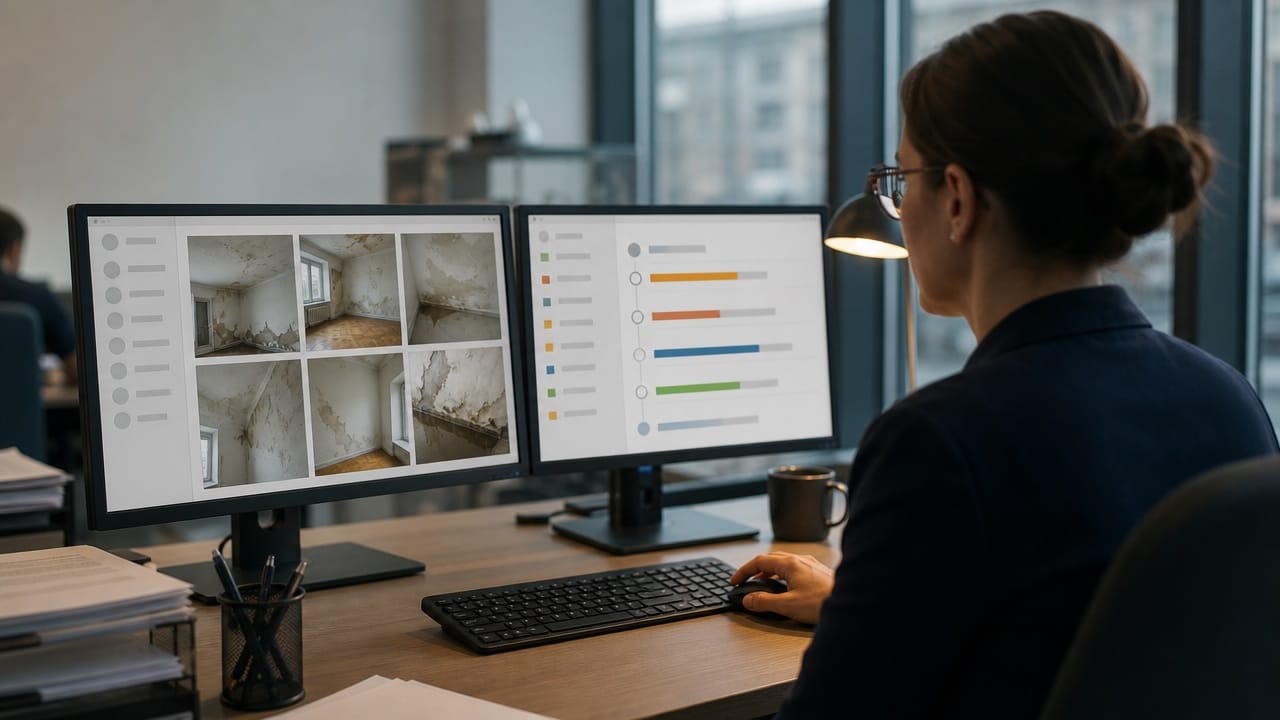
The customer sends the photos by email, mails the completed form, and calls to inquire about the status of their case. These three channels all end up in three different places. By the time the case manager pieces everything together, days have passed—and the customer calls again.
Meanwhile, the paper-based claim file physically makes its way from desk to desk. When it’s with the claims adjuster, customer service can’t access it. If additional information is needed, someone has to notice it, write a letter, and follow up to see if a response has been received. Every step is manual work, and every manual step is a potential source of error.
And then there’s the issue of status updates. The customer calls the call center, where the agent can’t access the claims system, so they take notes, make promises, and pass the information along. Two days later, someone calls them back—if they remember to.
This isn’t human error; it’s a system failure—and that’s exactly what digitizing the claims settlement process eliminates.
BürOffice automatically registers every incoming document and attaches it to the appropriate claim, whether it arrives by mail, email, through the client portal, or via Cégkapu. The system recognizes which case the client’s response belongs to, so it is automatically placed in the correct location.
Paper documents are not left unmanaged either; the system automatically files documents received by mail after scanning them and tracks the storage location of the original copy using a barcode. Damage photos and larger files are stored in the same file as the correspondence—not buried deep in a network drive.
Document management for claims is based on access permissions and full logging. The claims adjuster, the case manager, and the manager all view the same file—each at their own permission level. It is possible to track at any time who did what with the case and when.
The automation of the claims reporting process in BürOffice is structured as follows:
If no one responds in time at any step, the system escalates the task. A claims case doesn’t come to a halt just because someone is on leave.
Throughout the process, everyone involved sees the same information. The claims adjuster reviews the file on a tablet while in the field, the claims handler monitors the status of the inspection from the office, and the approver knows exactly what information to base their decision on. Automating the claims reporting process doesn’t take decision-making away from people—it eliminates the need to search for information.
When selecting claims management software, the decisive factor is not the list of features, but how well it integrates. BürOffice is added to your existing claims system, not in place of it—so your colleagues won’t have to learn a new core system. And good claims management software can be implemented in weeks, not years.
BürOffice does not replace the insurance system; rather, it operates alongside it. It reads and writes data via a REST API, web service, or SQL connection, ensuring that the claim number, status, and payment details are identical in both systems.
Implementation can be phased. First, only documents and correspondence are migrated to digital claims management; next come the workflows; and finally, the entire claims settlement process is digitized—all without disrupting daily operations.

Until now, the head of the claims department received a weekly Excel report that was already outdated by the time it was completed. The BürOffice dashboard shows in real time how many cases are pending, what stage they are in, and where someone has missed an internal deadline.
The system monitors both statutory and internal deadlines. If a case approaches a threshold, it alerts the manager; if it crosses it, it escalates the issue. The manager isn’t notified of the delay after the fact, but rather when there’s still time to take action.
KPI reports also make team performance measurable: they show who closed how many claims and in how much time. This data can be used for capacity planning and even performance-based recognition.
Since the digitization of claims processing, the change is evident in the numbers. The average call duration at customer service can drop from 15 minutes to as little as 5 minutes, because the agent can immediately see the status of the claim. With the elimination of duplicate data entry, the number of errors has decreased by 85 percent.
Behind the numbers lies time saved—claims no longer have to wait for mailing, signing, or searching. The same team closes more claims with shorter turnaround times—and the pace of claims settlement becomes predictable.
From the customer’s perspective, this means they receive a substantive response on their first call. They don’t have to repeat their story a third time, because the claims adjuster has the full history right in front of them. Claims settlement is the true test of an insurance company; this is where it’s decided whether the customer will renew their policy or switch to another provider.
Yes. BürOffice connects to other systems via the REST API, web services, or an SQL connection, and can work with multiple document repositories simultaneously.
The first phase of the system is typically put into production within a few weeks. We then schedule the rollout across the entire system without any downtime.
Yes. When there is a surge in claims following storm damage, the rules engine automatically classifies and prioritizes them, and the manager reallocates capacity to the backlogged work queues.
The system meets the high-level requirements for NIS2, complies with the GDPR, and provides authentic archiving in accordance with eIDAS—ensuring that the records remain admissible as evidence even decades from now.
Digitizing the claims settlement process pays off the fastest in areas where manual work is currently most prevalent. Request a free consultation—in one hour, we’ll review your claims process and show you where you can save the most time.

Lower costs.
Transparent operation.
Excellent CX.